


Song for Metabolizing Grief
Singing with others. Community singing has become a medicine to shift my energy. It isn’t a panacea for grief. I still sometimes end up on the floor in my sorrow. But in that heaviness of heart, I am not alone. I am surrounded by a village of song that supports the metabolization of the emotions that are waiting to move through me.
Song for Metabolizing Grief
Written by: Alexandra “ahlay” Blakely
Even as a grief tender, I sometimes catch myself running away from my own grief. The kind of grief where dreams and sleep feel safer than the agony -- until, that is, I awake in the darkness, to find grief laying right there waiting for me to rock her like a baby. The kind of grief where I seek to fill my days with busyness, community gatherings, exercise… anything to keep the grief at bay. But even then, I can feel grief lurking in the shadows, right behind the center of my throat. The kind of grief where, if I just stopped for one second, she would come rushing in, debilitating me for who knows how long. The kind of grief where I am not sure if I will purge or wail. The kind of grief where bed beckons like a tempting escape. Food, Netflix, and blackout curtains at 1pm. The kind of grief where I wish I could cancel everything and just disappear.
As someone who dedicates a large portion of her life to grief, to the sorrows of the world and the grief that others carry (both human and more than human), I need to strategically build joy and pleasure into my life. When I first began grief work I found succor in the famous quote by the poet William Blake, "The deeper the sorrow, the greater the joy." I understood this to mean that the deeper into my grief I allowed myself to delve, that the pendulum would naturally oscilate back and forth between these two binaries. And after years of waiting, and that not happening, I realized that I might have misunderstood.
What I have come to learn is that grief is a skill we build. It is a skill that is difficult to build, in part, because we live in a grief-phobic culture. We must practice it to become agile in it. And my, oh my, have I become agile in it! My grief muscle had become strong but my joy and pleasure muscles on the other hand had become weak and malnourished. I had gotten lost in the strength of my own grief. And although I do not regret that process at all, I did find myself longing for an equilibrium. I longed for something other than grief, something that would move me toward my fullest expression of being alive.
If I wanted to come back to a more central place from within the circle of my wholeness, I needed to cultivate practices of joy and pleasure. I started to pay attention to what practices had the capacity to shift my energy when I did them. For example, things as simple as focusing on my belly button when I inhaled and exhaled, walking in the forest, dancing, cold plunging, discovering more about my own desire and… drum roll… singing.
Not the singing you do alone in the shower or when no one else is home. Singing with others. Community singing has become a medicine to shift my energy. It isn’t a panacea for grief. I still sometimes end up on the floor in my sorrow. But in that heaviness of heart, I am not alone. I am surrounded by a village of song that supports the metabolization of the emotions that are waiting to move through me. Sometimes, through the singing, I am able to access ecstasy, sometimes I find an ineffable sense of inner calm through the collective co-regulation of nervous systems, entrainment and attunement. Sometimes it takes a few songs before “I feel better.” On the odd occasion, I don't feel better at all, yet somehow I always feel less alone.
Author and educator, Martin Prechtel says that in the Tz'utujil community from present day Guatemala use the same word for crying as they do for singing. And my mentor and colleague, Aaron Johnson, says that singing and grief are not separate. Singing, says Johnson, is a form of touch.
I am convinced that no one thing works for everyone. I am also convinced that we are living in a time when singing together is being remembered by the mycelial brain that is our collective knowing. It is this kind of communal singing that, despite colonization and genocide, many Indigenous cultures still practice today. The communal singing that my people forgot over 500 years ago and perhaps even much longer ago than that. For centuries, my ancestors also utilized communal singing in the oral tradition as a technology to pass stories and memories through time like time capsules to the future ones. Communal singing marked our initiations, rituals, ceremonies & celebrations. Communal singing was practiced by those that knew that song is medicinal. And through generations of assimilation into US culture, communal singing was sadly forgotten. Communal singing fell off the radar more and more as we were able to listen to music through machines. And gratitude to those who never forgot the magic of singing together, we are riding the ripples of their sacred work so that we can remember we’re not crazy for feeling the depth of our sorrow during times of collapse, that we were not alone, and that we do not need to do any of this alone, ever. Singing or grieving.
In my own experience, grief, more than anything, wants me to acknowledge her presence, honor her existence and alchemize her into something else. The way I have learned to do that best is through breath, the movement of my body, fresh air, cold water, and above all else: singing with others. Paradoxically, processing my grief through song has also become a way that I have learned to experience some of the greatest joys and pleasures in my life.
——————————————————————
Alexandra “Ahlay” Blakely lives on Coast Salish Land. She is a song carrier remembering that which was meant to be forgotten in her lineages (Ashkenazi, Scandinavian, Finnish, English, Scottish, Irish): song technology as connective tissues of the communal body. She blends song, body percussion, dance, stillness, breath & silence with the deepest intention to support others in remembering their inherent birthright to singing and rhythm. To learn more about her song circles and grief retreats visit her website and her current project WAILS: Songs for Grief, an album entirely dedicated to grief ro be recorded in summer 2023 with over 150 voices in the State of Washington. The album is inspired by the five gates of grief from Francis Weller’s book, The Wild Edge Of Sorrow.

Alexandra "Ahlay" Blakely
Alexandra "Ahlay" Blakely (she/her) is a song carrier, grief tender and ceramicist remembering that which was meant to be forgotten in her lineages. Her ancient ancestors of Old Europe (Ashkenazi, Scandinavian, Finnish, English, Scottish, Irish) sang, grieved and played together while building, creating, birthing, working & being in reciprocity with the Land. She understands these technologies to be fundamental in the expansion of one's internal capacity to participate in the collective shift towards life-affirming conditions. An underlying prayer in her offerings is that they may contribute to the shared effort to transform white culture into being more connected with our bodies, emotions, Land & the animate world around us.
To learn more about her work visit Healing at the Roots.
To support the upcoming album WAILS: Songs for Grief (an album entirely dedicated to collective grief) visit the gofundme.

Opening Wider Circles
Even as we celebrate the beauty and balm of connections within the circle, the emergence of authentic community by its nature invites the questions, “Who is left out and why? How do we re-dedicate our work to opening even wider circles?”
Statement of Support Progress Update
Diving deeper into support for this year’s summer programs has broken open the heart of Journeys for me with new clarity. Seeing the incredible dedication of staff and guides, the trust and vulnerability of participants and their families, and the stewardship of the Board and the wider Journeys’ circle, spiral into being as a newly woven tapestry of heartfelt community.
Even as we celebrate the beauty and balm of connections within the circle, the emergence of authentic community by its nature invites the questions: “Who is left out and why? How do we re-dedicate our work to opening even wider circles?”
Last summer, the Journeys Board committed to action and ongoing communication on its efforts to overcome unconscious bias, racism and other forms of oppression in ourselves and the circles of this organization, while staying grounded in Journeys’ vision and mission. To this end, we want to continue to report progress on our Board Action Plan.
Board Action Plan
Conduct a JEDI (Justice, Equity, Diversity and Inclusion) assessment working with external consultants to discover and reduce barriers to diversifying the Board and staff
Provide opportunities for field staff, administrative staff, committed community members and Board to engage in heartfelt discussions of race, power and privilege and participate in professional anti-oppression training
Partner with connected organizations to improve outreach to marginalized communities
Report progress on this work to stakeholders on a regular basis
Progress on Action Plan
March 2021
Board and Staff engaged in reflection and discussion as part of a multi-session training on Gender Identity and Wholistic Sexuality led by J Mase III. These conversations allowed time to unpack and examine assumptions, structures and language related to gender-identity and sexual orientation in Journeys’ work. Doing so helped us think more deeply about how we hold open the space for young people as they grapple with gender and sexual identity, how we attract and inspire Guides equipped with the experience to mentor them, and how we support families deciding which trips would best serve their youth in this regard.
April 2021
Board and Staff worked with Darcy Ottey and Kruti Parekh from Youth Passageways Education and Consulting Collective, on Transformative Justice and Repair Work. We explored principles of transformative justice in relation to our community’s historic and recent conflicts, with a focus on Journeys’ current processes and practices. These conversations revitalized a commitment to deepen Journeys’ capacity to repair the threads of connection inevitably frayed and torn as we lean into community. We’ve begun immediate work refreshing our conflict resolution processes and exploring an Elder Initiative that would include a non-governing council of elders offering support to Guides, Staff and Board on an as-needed basis.
May 2021
Janis Avery, the former CEO of Treehouse for Kids and a consultant on Social Justice and Equity issues, met with Staff and Board to provide input and resources for reducing barriers to diversity for Journeys’ Board, Staff and Guides. A Board Development Steering Committee was formed to identify, cultivate and recruit Board members who will bring diverse perspectives and experiences, and fill gaps in expertise. Focusing on fostering relationships, the Steering Committee has begun work to identify and reach out to BIPOC, Trans and Queer organizations, and individuals who are currently working in or with wilderness-based, youth service organizations. The goal is to build long-term relationships of mutual support as a foundation for possible recruiting to serve on the Board.
As all this continues to unfold, the passion and creativity of a Journeys’ summer highlights the transformative power of community and further energizes this work. I’ve experienced firsthand the dedication of Staff, Guides and Board to the continued learning and effort required to progress along this path. We’d also like to invite the extended Journeys’ community into this process, beginning with the summer closing ceremony and relaunch of Heart of Journeys gatherings (Saturday, September 4, 2021, 4-8:00pm at Songaia) as we continue to open our circles even wider.
In community,
Brian Bansenauer, Board of Rite of Passage Journeys
Related Articles




Rites of Passage – Cultivating Soul Sparks in a Dark Time
By Randy Morris, PhD
… It says that every human being is born, not as a blank slate to be passively written upon by social forces, but with an innate image, an acorn, an individualized soul image that is an inborn part of our psychic structure.
By Randy Morris, PhD
We live in strange and difficult times – the biggest pandemic since the 1918 flu, the biggest economic crisis since the 1929 depression, the biggest racial unrest since the riots and marches of the 1960s. It seems that society is unraveling before our eyes. What can a small nonprofit organization like Rite of Passage Journeys contribute to a world in need of hope and healing?
For over 50 years, Journeys has insisted that intentional rites of passage are necessary for the healthy growth of individuals and communities. A rite of passage is a set of ritualized activities that marks the transition from one phase of life to another. They typically take place at certain inflection moments in a person’s life – adolescence, mid-life and elderhood – though they can take place whenever a transformation from a lesser state of knowing to a greater state of knowing is required. Journeys has developed programs for all of these phases of life and in all of them a basic assumption is made about the nature of human nature. It says that every human being is born, not as a blank slate to be passively written upon by social forces, but with an innate image, an acorn, an individualized soul image that is an inborn part of our psychic structure.
This is true for every human being, no exceptions. It is our birthright, given freely to us by the Earth. This ‘soul-spark’, as the poet John Keats calls it, needs nurturing and guidance in order to grow into maturity. Every individual is responsible for doing the ‘soul work’ necessary to overcome limitations imposed on them by the circumstances of their birth or the social conditions that seek to keep them small. At Journeys, it is our job to create the conditions where the soul-spark of each person is welcomed, seen, valued and nurtured. In a world of troubles like ours, it is helpful to know that every person, without exception, has something to contribute to the solutions. We are each called in unique ways to mend the fabric of a torn world by uncovering and enacting our inborn gifts.
Unfortunately, the social conditions arrayed against our ‘soul spark’ can be quite formidable. A simple but comprehensive way to understand these forces comes from the Buddhist tradition, which says that all human suffering is caused by three mutually reinforcing poisons: greed, aggression and delusion. When these human forces are institutionalized, they become forms of consumerism (greed), militarism (aggression), and state and corporate-controlled media (delusion). These institutionalized poisons create a kind of ‘trance’ from which it is very difficult to ‘wake up’. This trance obscures the truth of our soul-spark, making it difficult to cut through the spin and hype of our culture, and preventing us from a clear view of the work we were given to do in service to the healing of our planet.
At Rite of Passage Journeys, we have found that nature-based soul work in the company of a beloved community is the best way to break the trance of late-stage capitalism, and wake-up to the soul-spark within each of us that yearns to express itself in acts of compassion, beauty and solidarity. For any who have witnessed the return ceremonies of our youth trips, when participants show up tired and dirty but with a new-found clarity in their eyes; or felt the buzz of excitement at the end of one of our adult programs, you know first-hand what it looks like to have awoken from a trance. Of course, life-span rites of passage imply that discerning and fulfilling our soul-spark is not a one-time event, but rather a living, dynamic process that extends across a lifetime, from adolescence to mid-life to elderhood and death. As we awaken from trances within trances, we become more conscious and thus more able to repay the Earth for her gift of life and the soul-spark within.
What happens when the body undergoing a rite of passage is a collective body, like the American public, or humanity as a whole? Do the same dynamics of a rite of passage described above hold for the collective as well as the individual? The short answer is ‘Yes!’. Things seem so dire because we are engaged in a global rite of passage for humanity as a whole. The earth cannot support the injustices being visited upon it. We have to move to a sustainable world. A rite of passage is being called for so that the soul-spark of humanity can realize itself. This will require us to wake-up from trance states that are destroying the earth so that we can become a more conscious species, dedicated to the cause of life and celebrating, as only humans can, the wonders of the beloved earth community and the sentient cosmos which gave it birth.
Further Reading: To explore some of the ideas behind this blog post, enjoy the following:
Anne Baring, The Dream of the Cosmos: A Quest for the Soul (2013)
Thomas Berry, “The Dream of the Earth: Our Way Into the Future,” Chapter 15 in The Dream of the Earth (1988)
Michael Meade, The Genius Myth (2016). See also www.mosaicvoices.org
Andrew Harvey and Carolyn Baker, Savage Grace: Living Resiliently in the Dark Night of the Globe (2017).
James Hillman, The Soul’s Code: In Search of Character and Calling (1997)
Joanna Macy and Molly Young Brown, Coming Back to Life: The Updated Guide To The Work that Reconnects (2014)
Bill Plotkin, “Inscendence – The Key to the Great Work of Our Time: A Soulcentric View of Thomas Berry’s Work”, in Laszlo and Combs, eds., Thomas Berry, Dreamer of the Earth: The Spiritual Ecology of the Father of Environmentalism, 2011.
Andres Rodriquez, The Book of the Heart: The Poetics, Letters and Life of John Keats (1993)
Richard Tarnas, “Is The Western Psyche Undergoing a Rite of Passage?” at https://cosmosandpsyche.files.wordpress.com/2013/05/revision-rite-of-passage.pdf
Related Articles


Echoes of Grief - a recounting of Ritual and Reclamation
By Patti Kwok
…She walks the perimeter of chairs containing a reservoir of grief seen in the dark forest pools of another’s eyes, that arrested posture, the smell of secret longings, a place for uncovered grief to finally rest; tremors of hesitation break the sound barrier of forgotten depths where ritual matters.
By Patti Kwok, participant Grieving Time 2019
On this Saturday afternoon, she enters a remodeled building in the heart of Sunset Hill, a neighborhood of Seattle Washington. In the partial sunlight, the community center is washed in the afternoon shades of fading paper whites and dandelions, cream cheese and buttered popcorn; portions of the building just passed over by the approaching fall evening and its unfolding blanket of gray chill. November’s canopy alters from ivory fleece to rosy Camelian, mandarin blush becomes turmeric gold and her gilded anchor sinks into a vast sea of star-studded navy and indeterminate black — a beautifully arranged marriage of fire and gravity.
Entering the upstairs doorway off the newly remodeled deck, she feels a sense of divinity, trusting the light and its tempting pull of embracing angles; it is a house of belonging. The floors are a beautiful oak, creaking sweetly in places like an old wooden bridge, a horse’s weathered saddle, the atrium of a 19th century hotel, or the slant of a well-worn hallway. Within her first breath, the familiar sorrow rushes back like the unsettled salt of ocean, dry prairie, an acre of soil she can never properly tend. She walks the perimeter of chairs containing a reservoir of grief seen in the dark forest pools of another’s eyes, that arrested posture, the smell of secret longings, a place for uncovered grief to finally rest; tremors of hesitation break the sound barrier of forgotten depths where ritual matters.
Several people kindly acknowledge one another: a man who lost his wife months ago, a recent suicide, a coveted red Swiss army knife from a brother who died long ago, many stories palpable although not quite felt or heard. Artifacts brought from home — photographs, statues, a small metal bicycle, stones carefully chosen from a basket — objects placed on the altar as a life remembered, an earth deeply loved. She fiercely protects her own burden as the ritual has not yet begun. An older man tells her she must download the new app Finding Fred — inviting Fred Rogers back for the wounded adult, the familiar voice of a revolutionary, a spiritual herald and his radical knowing donned underneath a red cable-knit sweater. Invited into beginning ritual, she enters the depth of love beyond fear.
We know that we have left death and come over into life; we know it because we love others (1 John 3:14)
Sitting in a circle of sharing, reality comes flooding back — she, too, will lose everything she’s ever loved; but she knows love cannot be kept in the grave. The ritual begins in sacred drumming, depicting the communal heartbeat of longing, that bridge to a forgotten sense of belonging, the primal rhythm of memory and mother, earth and harvests, prosperity and lasting riches. In chorus of evocation, enacted by each of the three facilitators, they bow in all directions. We are guided by ethereal emotional chants and borrowed lyrics from the gods. We enter the untamed world of muse and her many indifferent seasons. The dance of Kairos and her timeless redemption enters the temple, and she engages with the depths of a forgotten freedom.
Nature’s mandala is constructed from the center out in green willowy fern, a circumference of soft brocade pillows, shooting stars of candlelight illuminate the protected center of grief, surrounded by three other circles — one of nurturing, protecting, and a familiar village on the perimeter where torment is resurrected and levity and mirth take shape in redeeming shadows, where the painted Bacchae take to the hills of wilderness, dancing more freely. Immersed in candlelight and the sacred movement of ritual, she sings the chorus of soul allowing grief to make evident the forgotten joy after loss. From aching heart to open heart, she falls into a devotional trance that reclaims her deeper meaning towards the lost art of being.
Thirty minutes into the wild frenzy of scattered emotion, falling like leaves and stars, they have broken through oppressive shadows, beyond the sound barrier of Cronos, into a new dawn of time and place. She is pulled towards the altar of radiance, surrendering to a large silky cushion, sacrificing a known way of being — remembering that we are all children of the earth’s dreaming, now pulled into the center of our own belonging, once rootless now tethered — no longer afraid of the invisible, what seemed impossible to know. Wailing and the lonely scream of hunger opens the sentinel gates of psychic numbing — lose and wild weeds tumble into the turbulent matrix of sweat and tears, the lightning strikes, the rains flood, lungs fill with the alchemy of fresh air, ghosts with painted faces masked in red and black wander in the haze of afterlife, building bridges between the visible, the imaginary, the intangibles; ritual leaves nothing in the dark — flames become a galaxy of stars, shorebirds sing towards a rising dawn, the withered sedge returns along jagged shores. Silver tones of fish from the river’s edge are kissed alive by the cycles of sun and moon and the tilting gravity of a re-discovered soul. We must taste the death of our nature.
Her stony brick of a wounded heart softens into clay, malleable through the curves of time, pulsing with force through the great dams and arteries of grief. Bodies lie in the fertile soil like cocoons hanging from emerald chains of forest, wings form in the shadows of fallen stars, the center circle of sharing becomes a sculpted topiary of broken emotion, tangled threads of red rage unravel secrets left buried far too long. We are like borrowed dust, but something new has been written in the ashes of our lives; like the caterpillar — we were too small to live. New wings carry the intelligence of stars. We leave death and come over into life.
Encountering Grief
excerpt of a guided meditation from Joan Halifax
Bring attention to the breath, let the breath sweep your mind, notice if deep or shallow
Recall for a moment a loss or losses that have really touched you, or the anticipation of loss
Offer some simple phrases:
~ May I be open to the pain of grief
~ Notice whatever comes up, not rejecting it, not clinging to it
~ May I find the inner resources to really be present for my sorrow
~ May I accept my sadness, knowing I am not my sadness
~ May I and all beings learn from and transform sorrow
~ May I be open to the peace and joy that grief eventually brings
~Joan Halifax
Related Articles
Creating ‘The Beloved Earth Community’ At Rite of Passage Journeys
By Randy Morris, PhD
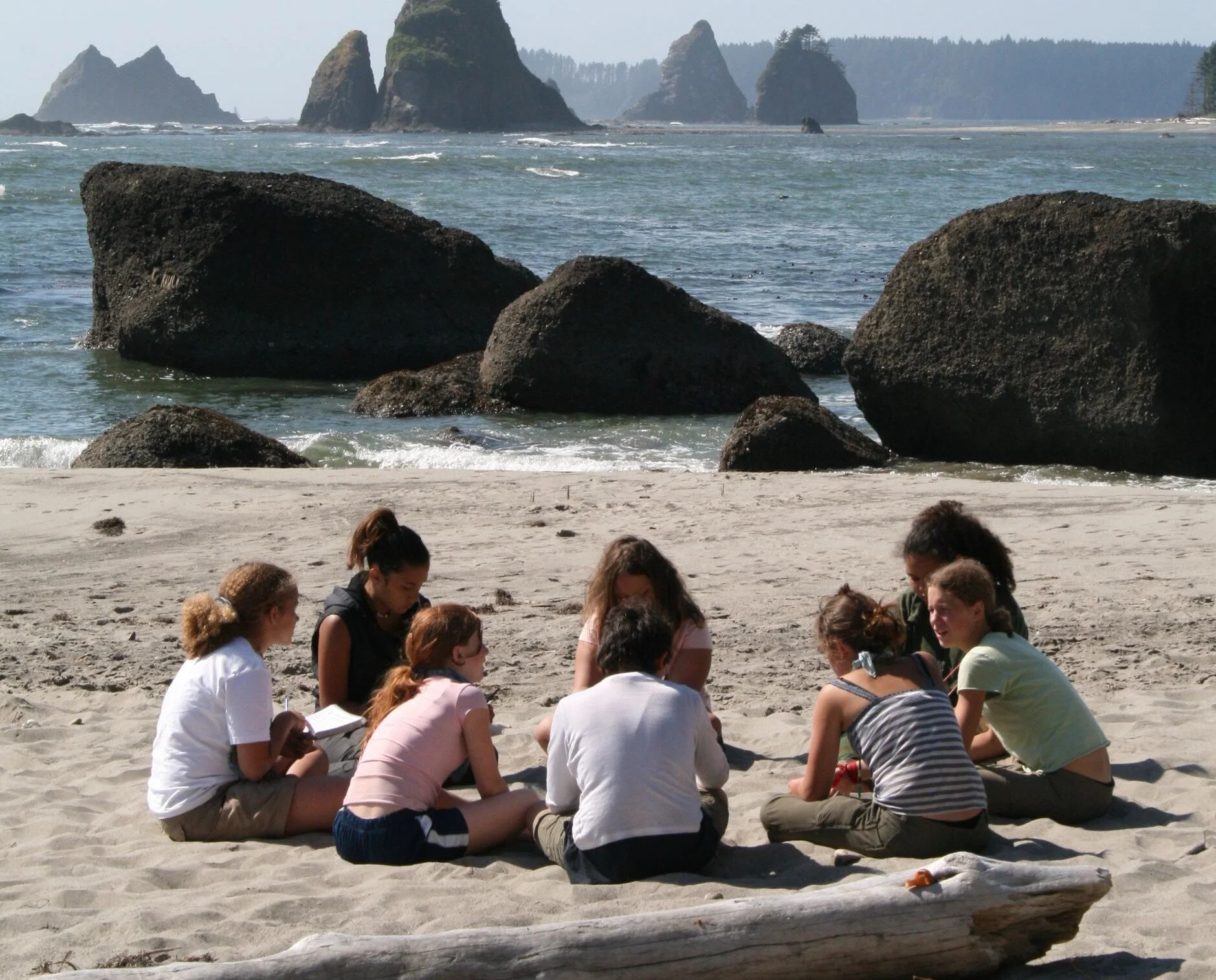
An experience that is common to participants at Journeys is the strong sense of solidarity that is created while on a wilderness trip or experiential weekend. What heads out as a group of strangers often returns to base camp with deep friendships that seem more intense than much longer relationships back home.
By Randy Morris, PhD
An experience that is common to participants at Journeys is the strong sense of solidarity that is created while on a wilderness trip or experiential weekend. What heads out as a group of strangers often returns to base camp with deep friendships that seem more intense than much longer relationships back home. The same phenomenon often occurs in large weekend events that involve ritual and soul work. An energetic field is constellated and participants report tremendous connection and compassion as a result of engaging in deep and sometimes difficult emotional work as a group. The very word ‘compassion’ means a ‘suffering’ (-passio) ‘with’ (com-). This feeling of connection is a hallmark of healthy cultures. The fact that it is so rare is an indication of our broken society, in which online friends can seem closer and ‘more real’ than in-person friends.
In listening to Journeys participants dialogue with each other about their sacred experiences in nature, both in the moment and in reunions years later, I am struck by the way the normal course of time dissolves. As the story unfolds, the participant’s ‘soul work’, consisting of shared moments of overwhelming feeling and intense insight, seems to be happening again in the moment of telling. This is made possible by ‘deep listening’ in the presence of a true ‘soul friend’, one who ‘listens their way’ into the heart of the other, sees their inner light, and wants to support the radiance that is trying to grow there.
The mythologist Michael Meade says that an old term for the human soul is ‘the light hidden in darkness’. (1) There is no greater blessing than to have one’s inner light seen and witnessed. In the Jewish tradition of friendship, Meade says, the ‘angel of friendship’ is constellated when the spark of life in one person meets the spark in the other. Their lights are conjoined, which adds more light to the collective light of humanity. In these dark times, the light of creation wants to grow, but it can only do so through the light of the souls who are alive today. The work of Journeys is to provide conditions where these kinds of soul relationships can thrive.
To what end? Is there an aspirational goal to the work of Rite of Passage Journeys? Perhaps the best articulation of the overall purpose of our work comes from the cosmological vision of Martin Luther King, Jr. King is best known for his work on behalf of social justice. But what is often overlooked is the ecological and cosmological origins of his vision of the Beloved Community. King wrote, “As nations and individuals, we are interdependent. It really boils down to this: that all life is interrelated. We are all caught in an inescapable network of mutuality, tied into a single garment of destiny. What affects one directly, affects all indirectly. We are made to live together because of the interrelated structure of reality.” (2)
This is a worldview that was far ahead of its time and it contains just the healing balm we need for our fractured world. As articulated by Drew Dellinger, whose doctoral dissertation was entitled, “The Mountaintop Vision: Martin Luther King’s Cosmology of Connection,” King’s cosmological vision has the capacity to unite the quest for ecological sustainability with the quest for social justice. (3) If social justice is human love made visible, then ecological justice is cosmic love made visible. The Beloved Earth Community is a vision of a world made whole through a cosmology of justice in which interdependence and compassion are woven into the fabric of the cosmos itself.
The universe, in King’s view, has a moral dimension, and it is “on the side of justice.” (4) In this sense, Justice is a dimension of the cosmic life force itself. In its embrace, everything belongs. Everything co-arises together and is dependent on everything else, whether human or more-than-human. It’s not ‘The Beloved Human Community’ but ‘The Beloved Earth Community. We are all in this together. This is not a simplistic version of everyone just getting along with each other, but an all-inclusive and radical vision in which the inner light of the human soul, the subjectivity of rocks and trees and the bright light of the sun each have their rightful place, their ecos, their home, in a universe that yearns for justice. When all are in ‘right relation’ with each other, the desire of the universe for justice will be fulfilled. In a world made dark by greed, ignorance and violence, this is a startling vision of hope and guidance for the future. (5) By encouraging deep soul work in order to enhance a sustainable earth-human relationship, Rite of Passage Journeys is striving to do its part to foster the Beloved Earth Community.
Endnotes:
Taken from Michael Meade’s excellent podcast on “Angels of Friendship”, Living Myth Podcast #101, at www.mosaicvoices.org.
From Martin Luther King, Jr., “A Christmas Sermon on Peace,” in James Washington, ed., A Testament of Hope: The Essential Writings and Speeches of Martin Luther King, Jr., (New York: Harper Collins), 1986, p. 254.
Drew Dellinger, “Dr. King’s Interconnected World”, New York Times Op-Ed, Dec. 22, 2017. For more of Dr. King on cosmological justice, see Drew Dellinger’s website at www.drewdellinger.org.
This is a common refrain in King’s work. A concise statement of it can be found in King’s essay on “The Power of Non-Violence” in A Testament of Hope, pp. 13-14.
For more on developing ‘right relationship’ with those with whom you disagree, see King’s sermon, “Loving Your Enemies” in Strength To Love, (Philadelphia: Fortress Press), 1963.
A wilderness rite of passage doesn’t begin when a participant arrives at the trailhead or end the moment they return home.
The weeks and months surrounding a rite of passage can be just as juicy as time spent in the wilderness. The experience itself plants a seed: a taste of independence, a new sense of wonder at nature, a question about identity, or a glimpse of who we might become. But what happens next is what allows that seed to burst into glorious bloom.
That’s why, at Rite of Passage Journeys, we see autumn as an essential season in the spiraling path of a rite of passage. When the energy and vitality of summer abate, we enter a season that invites us to cool off, slow down, and marvel at the changing colors of the landscape – both out in the world and deep inside.